


[Research Paper] “Financial Burden of Menstrual and Menopausal Symptoms: Productivity Loss from Absenteeism and Presenteeism Among Working-age Women” Published in Reproductive Health (May 30, 2026)
date : 6/16/2026
Tags: Women's Health

![[Research Paper] “Financial Burden of Menstrual and Menopausal Symptoms: Productivity Loss from Absenteeism and Presenteeism Among Working-age Women” Published in Reproductive Health (May 30, 2026)](https://hgpi.org/en/wp-content/uploads/sites/2/lecture-media-376-top-1.png)
A paper drawing on research by the Women’s Health Project of Health and Global Policy Institute (HGPI), titled “Financial burden of menstrual and menopausal symptoms: productivity loss from absenteeism and presenteeism among working-age women,” has been published as an open-access article in the international journal Reproductive Health.
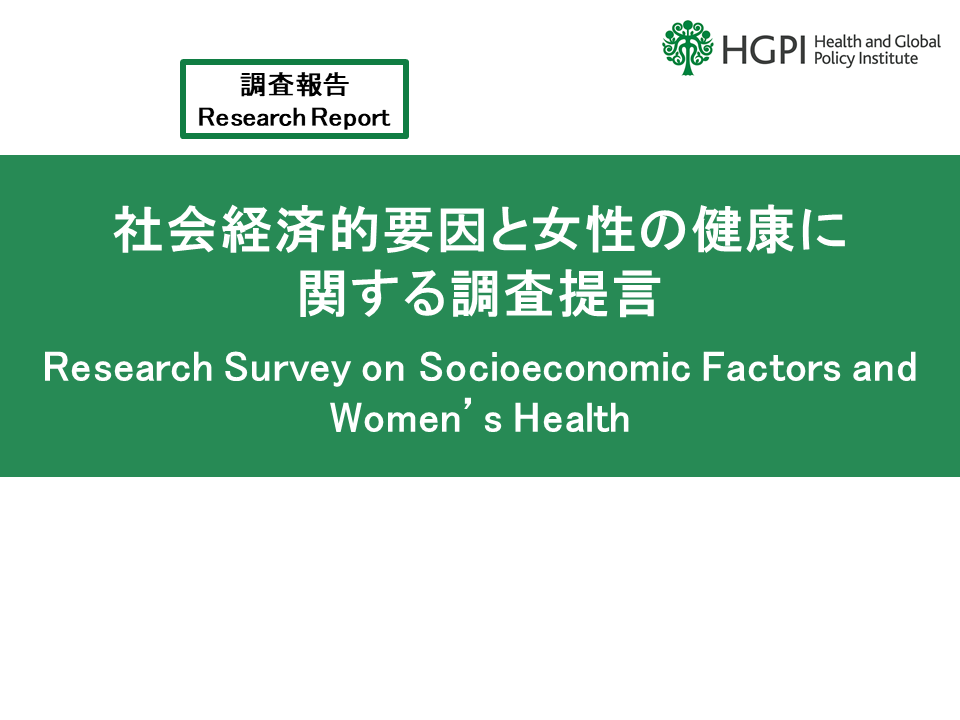
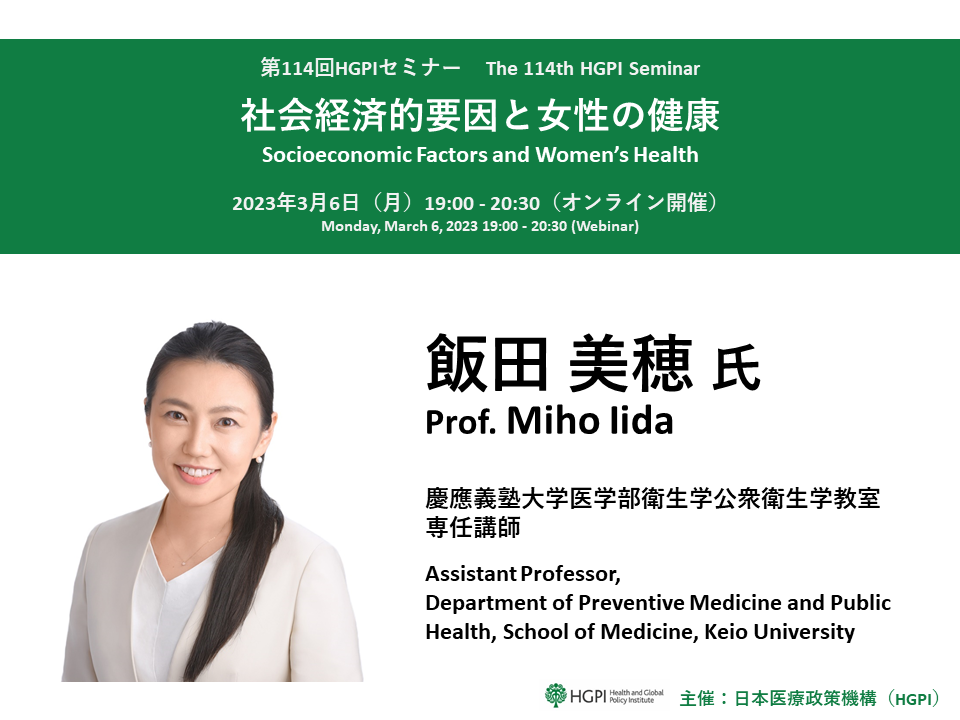
The paper is based on the underlying data from the survey report “Recommendations on Socioeconomic Factors and Women’s Health,” which HGPI released in March 2023 to coincide with Women’s Health Week. Drawing on an internet-based survey of 10,000 men and women aged 25 to 59 conducted across Japan in September 2022, the study analyzed responses from 3,046 working women and used the validated Work Productivity and Activity Impairment (WPAI) questionnaire to estimate, at the national level, the financial impact of productivity loss (absenteeism and presenteeism) attributable to menstruation- and menopause-related symptoms.
Key findings include:
- Approximately 7.0 to 8.8 percent of working women experienced absenteeism or reduced working hours because of these symptoms.
- Menstruation- and menopause-related absenteeism accounted for 2 to 3 days off and a reduction of 2 to 5 working hours over the preceding three months.
- 79.7 percent of women reported that menstrual or menopausal symptoms affected their work productivity.
- The estimated annual national financial burden of productivity loss arising from these symptoms is approximately JPY 2,296.30 billion (USD 14.65 billion), comprising JPY 323.95 billion (USD 2.07 billion) from absenteeism and JPY 1,972.35 billion (USD 12.59 billion) from presenteeism.
These findings indicate that addressing menstruation- and menopause-related symptoms among working-age women holds potential not only for building gender-responsive, supportive workplaces but also for generating substantial economic benefits. To ensure that all women can fully participate in social and economic activities, workplaces should adopt strategies that meet women’s sexual and reproductive health needs.
This paper was led by a research team headed by Dr. Shohei Okamoto (corresponding author, University of Tsukuba), drawing on the underlying data from the above survey. From HGPI, Mr. Shu Suzuki (Associate, HGPI) and Dr. Haruka Sakamoto (Senior Manager, HGPI) participated as co-authors.
The published paper is available here: Kasahara S, Goto R, Suzuki S, Sakamoto H, Okamoto S. Financial burden of menstrual and menopausal symptoms: productivity loss from absenteeism and presenteeism among working-age women. Reproductive Health (2026).
The survey report on which this paper is based is available here: “Recommendations on Socioeconomic Factors and Women’s Health” (March 6, 2023)
Related Posts
Top Research & Recommendations Posts
- [Research Report] Energy Conservation and Greenhouse Gas Emissions Reduction in Healthcare Facilities: Case Studies from New Construction and Facility Renewal (March 16, 2026)
- [Public Comment Submission] “The 7th Science, Technology and Innovation Basic Plan” (Draft) (February 19, 2026)
- [Research Report] Perceptions, Knowledge, Actions and Perspectives of Healthcare Organizations in Japan in Relation to Climate Change and Health: A Cross-Sectional Study (November 13, 2025)
- [Policy Recommendations] Policy Recommendations in the Field of Blood Disorders “Building a Healthcare Ecosystem Centered on Patients and Those Affected” (April 13, 2026)
- [Event Report and Discussion Points] AI Diagnostic Support Project Expert Meeting: “The Roles of Industry, Government, Academia, and Civil Society in the Era of AI-Assisted Diagnosis” (May 25, 2026)
- [Research Report] The 2025 Public Opinion Survey on Healthcare in Japan (March 17, 2025)
- [Policy Recommendations] Dementia Project “The Future of Dementia Policy Surrounding Families and Others Who Care for People with Dementia” (April 27, 2026)
- [Policy Recommendations] Reshaping Japan’s Immunization Policy for Life Course Coverage and Vaccine Equity: Challenges and Prospects for an Era of Prevention and Health Promotion (April 25, 2025)
- [Research Report] The 2026 Public Opinion Survey on Healthcare in Japan (February 13, 2026)
- [Policy Recommendations] Developing a National Health and Climate Strategy for Japan (June 26, 2024)
Featured Posts
-
2026-05-13
[Registration Open] HGPI Salon 2025-2026 Looking Ahead to the Future of Japan’s Social Security System “Session 5: The Value of Healthcare in Society – Perspectives from the Reiwa Era” (June 29, 2026)
![[Registration Open] HGPI Salon 2025-2026 Looking Ahead to the Future of Japan’s Social Security System “Session 5: The Value of Healthcare in Society – Perspectives from the Reiwa Era” (June 29, 2026)](https://hgpi.org/en/wp-content/uploads/sites/2/5thHGPISalon_20260629.png)
-
2026-06-04
[Registration Open] (Webinar) The 3rd J-PEP Seminar “Social Participation of People with Intractable Diseases and the Potential of a New Way of Working — ‘RD Workers’ — Lessons from Policy Advocacy Practice” (July 22, 2026)
![[Registration Open] (Webinar) The 3rd J-PEP Seminar “Social Participation of People with Intractable Diseases and the Potential of a New Way of Working — ‘RD Workers’ — Lessons from Policy Advocacy Practice” (July 22, 2026)](https://hgpi.org/en/wp-content/uploads/sites/2/HGPI_20260722_The3rd-J-PEPseminar.jpg)
-
2026-06-15
[Registration Open] (Hybrid Format) Multidisciplinary Symposium for Cardiology, Nephrology, and Metabolic Medicine “Future Actions for Making Full Use of the Health Checkup System: Connecting Checkups to Treatment From the Perspective of Data Linkage” (July 6, 2026)
![[Registration Open] (Hybrid Format) Multidisciplinary Symposium for Cardiology, Nephrology, and Metabolic Medicine “Future Actions for Making Full Use of the Health Checkup System: Connecting Checkups to Treatment From the Perspective of Data Linkage” (July 6, 2026)](https://hgpi.org/en/wp-content/uploads/sites/2/Multidisciplinary-Symposium_20260706-top.png)
